HOT LINE: +86-510-80628100
Process Technology of Forged Steel Backup Rolls
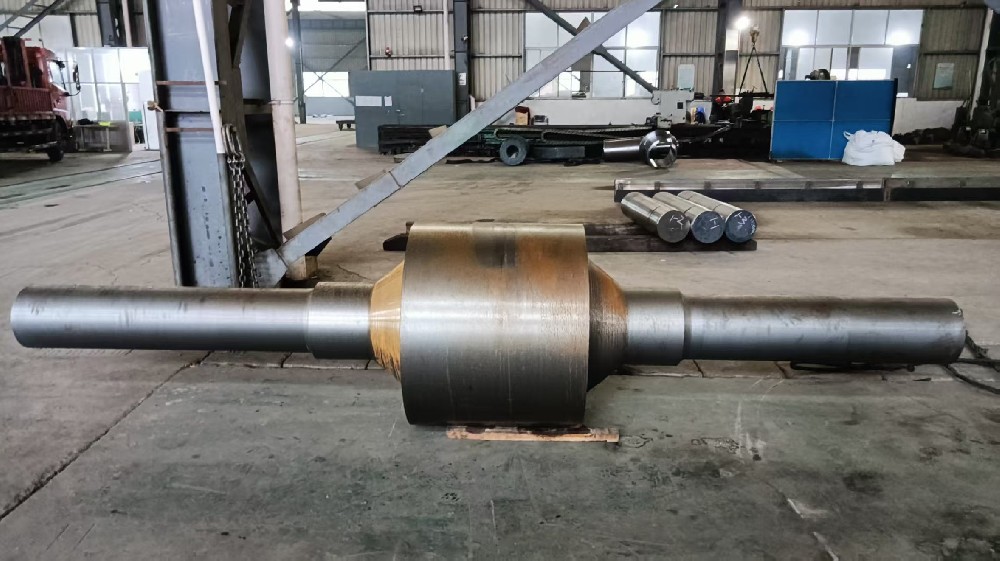
At present, the mainstream production process of backup rolls is as follows: electric arc furnace (medium-frequency furnace) smelting → ladle refining → vacuum degassing (VD) → bottom pouring (top pouring with vacuum casting) → hot transfer of ingots to forging process → homogenization treatment and forging → post-forging heat treatment (normalizing or annealing) → rough machining and ultrasonic testing → preliminary heat treatment (water quenching and tempering or oil quenching and tempering) → semi-finishing → power-frequency quenching (differential temperature quenching) → secondary tempering → finishing → fine grinding → finished product ultrasonic testing.
Unqualified defects in ultrasonic testing of backup rolls mainly originate from ingot smelting, forging and heat treatment processes. Common defects during ingot smelting include shrinkage cavities, porosity, non-metallic inclusions, etc.; typical defects in forging comprise flakes, coarse grains, cracks, etc.
Main Ultrasonic Testing Standards for Forged Steel Backup Rolls
JB/T 4120-2017 Standard
Most domestic manufacturers currently comply with the industrial standard JB/T 4120-2017 for backup rolls. Its core requirements are: no cracks, flakes or other defects shall exist in the entire backup roll; for solid forged backup rolls, the surface layer 100 mm deep from the roll body surface shall be inspected with dual-element probes. For backup rolls with a roll body diameter not exceeding 1600 mm, no defects with an equivalent diameter larger than Φ1 mm are allowed; for those exceeding 1600 mm, no defects larger than Φ2 mm equivalent diameter are permitted. In other ultrasonic testing zones, if a single defect echo continuously maintains F ≥ 1/2 full screen height, the area of defects where the first bottom echo amplitude BF at the defect location is ≤ 1/2 full screen height shall not exceed 25 cm2. This standard has been implemented in China for many years, and products conforming to it can basically meet user requirements.
SN 322.10 Standard
This standard is adopted by some overseas users. It is stricter than JB/T 4120-2017. Compared with JB/T 4120-2017: the requirements for the working layer are basically consistent, posing similar difficulties in manufacturing. However, requirements for the internal roll body differ significantly. JB/T 4120-2017 adopts the bottom echo method, where defects are deemed acceptable if they do not affect the bottom echo. In contrast, SN 322.10 not only imposes strict regulations on the amplitude influence on bottom echoes but also requires equivalent method testing to quantify defect size, with the number of defects not exceeding 5.
EN 10228.3 Standard
This standard is mainly used by European enterprises. Ultrasonic testing qualification of backup rolls is mainly determined by the equivalent method, generally adopting Grade 2 and Grade 3 criteria. Taking Grade 2 as an example, inspected with straight beam probes, single-point defects below Φ8 mm and continuous defects below Φ5 mm are permissible.
ASTM A388 Standard
(1) Straight beam testing: a) No defect echoes exceeding a specified percentage of the reference bottom echo are allowed; b) No defect echoes equal to or larger than those from a specified reference flat-bottomed hole are permitted; c) No zones where the bottom echo is reduced beyond a given percentage of the reference bottom echo are acceptable; d) No defect echoes as specified in a) and b) accompanied by bottom echo reduction as in c) are allowed; e) No indications exceeding the reference line specified in the DGS method are permitted.
(2) Angle beam testing: No indications exceeding a specified percentage of the reference groove echo amplitude or amplitude reference curve are allowed.
Generally, technical agreements stipulate that no zones with defect waves > 20% and bottom wave loss greater than 70% are permitted.
Testing Defects Caused by Segregation and Shrinkage Cavities in Large Backup Rolls
(1) Research on internal ultrasonic testing defects of extra-large backup rolls shows that dense defects in such rolls are mainly caused by inhomogeneous microstructure and grain size, which in turn result from chemical segregation. Specifically, segregation leads to uncoordinated local deformation during forging, initiating internal microcracks. Meanwhile, severe segregation adversely affects phase transformation during heat treatment. China Erzhong Group verified through high-temperature diffusion tests that prolonged holding at 1250 °C can resolve segregation and improve testing performance.
(2) Investigation into the absence of bottom echoes in Cr5 backup roll bodies revealed distinct voids and microvoids on defect cross-sections, with no ductile tearing features. Electron microscopy and other analyses confirmed these defects as secondary shrinkage cavities. Insufficient feeding during ingot solidification enlarges the scope of secondary shrinkage cavities. If the forging ratio during the drawing-out compaction process is too small, secondary shrinkage cavities in the ingot core cannot be fully welded, resulting in the loss of bottom echoes during testing.
In addition, the high chromium content in backup rolls increases molten steel viscosity and reduces fluidity, making inclusions less likely to float and form inclusion defects. To prevent such defects, on the one hand, external inclusions must be controlled, such as polishing ingot molds and bases, and selecting appropriate refractory materials; on the other hand, proper control of casting temperature helps promote flotation of inclusions.
Conclusion
(1) The problem of Grade 4 network carbides and a small amount of eutectic carbides in Cr5 forged steel caused by improper post-forging heat treatment design can be solved by optimizing the heat treatment process. High-temperature normalizing is adopted to dissolve most carbides into the matrix, followed by rapid cooling using water-based or oil-based quenching media to ensure full austenite transformation, reduce precipitation of secondary carbides, thereby sufficiently refining the microstructure and avoiding the formation of network carbides. Ultimately, zero defect echoes and favorable bottom echoes are achieved in testing.
(2) During production of CrMo steel grades in the rainy season, exposed molten steel or open casting easily absorbs water vapor, oxygen and nitrogen from air, leading to excessively high H, O and N contents in ingots, causing gas porosity or flake defects during subsequent solidification. This issue can be addressed by applying atmospheric protection and adding mold flux.
(3) Segregation is inevitable in large ingots during casting. When segregation reaches a certain level, dense testing defects occur, which can be effectively mitigated by high-temperature diffusion before forging. Secondary shrinkage cavities also cause unqualified testing results, requiring a reasonable riser ratio design.