HOT LINE: +86-510-80628100
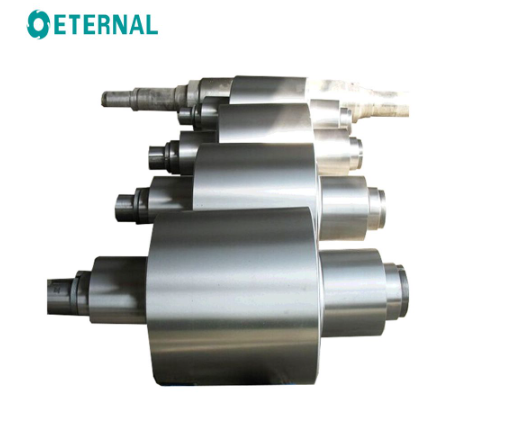
The support roll is the most commonly used type of rolling mill, which plays a supporting role in the rolling mill to prevent the deformation of the working roll during rolling and affect the quality and output of the sheet metal.
Manufacturing methods and classification
The manufacturing methods of support rollers mainly include forging and casting. The hot working process of forged steel support rollers mainly includes smelting (to obtain pure metallurgical quality), casting, forging (to achieve uniformity of structure), and heat treatment, so that the working layer of the produced support roller body can achieve high wear resistance, high and uniform hardness, and excellent accident resistance. At the same time, it ensures that the core and neck of the roller have high toughness and strength, to ensure the dimensional accuracy and good surface quality of cold-rolled strip or steel plate. According to usage classification, forged steel support rolls can be divided into forged steel cold rolling rolls and forged steel hot rolling rolls. Forged steel cold rolling rolls are used for cold rolling; Forged steel hot rolling rolls are used for rough rolling and hot rolling of steel sections.
Material selection
The development of forged steel support rollers should first consider the material of the rollers, which is determined by the characteristics of the use of the support rollers. The performance of the supporting roller includes: 1) wear resistance; 2) Accident resistance; 3) Surface shear stress resistance; 4) Hardenability. The user requests to reduce roller consumption and deepen the working layer of the support roller, therefore, it is necessary to improve the hardenability of the support roller material.
From the perspective of material usage both domestically and internationally, it has evolved from Cr2 to Cr3, Cr4, and transitioned to Cr5. Forged steel support rollers are mainly made of medium and high carbon alloy steel containing chromium, which has high quenching hardness and hardenability. After quenching and tempering heat treatment, the surface hardening layer can obtain martensitic, bainitic, pearlite or martensite structures.
Smelting process
Due to the large size and weight of steel ingots, double vacuum steelmaking is generally used. The main process flow includes: electric furnace rough refining of molten steel, LF furnace, alloying, refining furnace vacuum (VD), vacuum casting, etc.
Forging process
The supporting roller is a shaft forging, with a roller body length generally between 1400-2300mm. The diameter of the supporting roller for hot and cold rolling mills is usually between 1250-1630mm. The diameter of the forging is relatively large, weighing 20-70t, and the steel ingot used is 69-119t. For the supporting roller, upsetting is used to increase the diameter. The Cr type support roller material contains a high amount of carbon and alloy, and there are a large number of secondary carbides during forging. The internal deformation resistance of the steel ingot is relatively high, and there is poor internal and external resistance. The surface is prone to cracking, which greatly affects the compaction effect. In actual production, in order to solve the contradiction between compaction and surface cracks, the support rollers are usually produced using high-temperature, large reduction, wide upper and lower V-shaped anvil forging method.
Heat treatment process
By post forging heat treatment, the matrix structure is spheroidized to prepare for the next step of microstructure preparation, using high-temperature normalizing, spheroidizing annealing, and tempering processes. Preparatory heat treatment mainly involves adjusting the structure of the roller body, ensuring the hardness of the roller neck, and forming a good comprehensive mechanical performance of the supporting roller. When performing differential heat treatment, the core is still at the austenitizing temperature, and the surface reaches the quenching temperature at a certain depth. After quenching, the tensile stress in the core is significantly reduced, thereby improving the anti accident ability of the support roller.